

- Home
Advancing transformation: Key outcomes from the EUt+ Troyes Week
Published on March 25, 2026
–
Updated on March 25, 2026
Dates
from March 16, 2026 to March 20, 2026
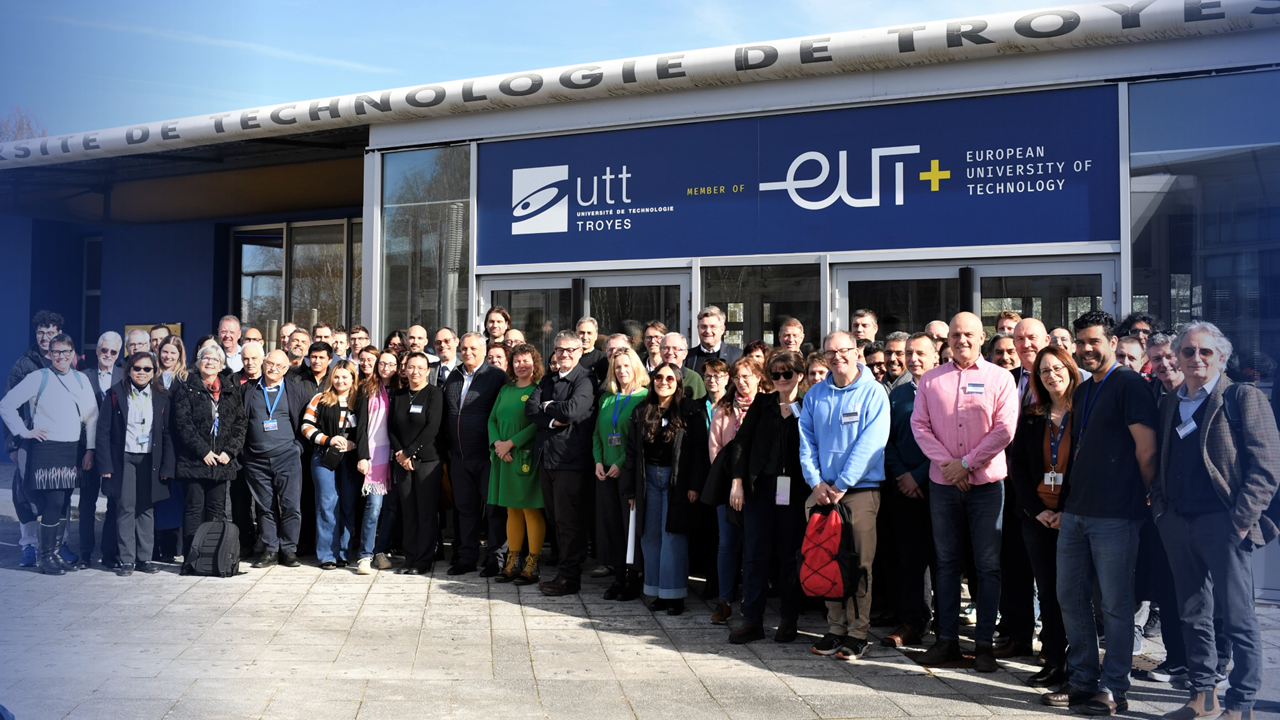
From 16 to 20 March, partners of the European University of Technology (EUt+) gathered in Troyes for the EUt+ Week, bringing together multiple Work Packages, tasks, European Research Groups (ERGs) and European Research Institutes (ERIs). The objective was to take stock of ongoing activities, strengthen alignment across work packages and thematic groups, and accelerate progress towards the alliance’s shared ambition.
Across WPs and tasks, a shared realisation emerged: the foundational building blocks for transformation are now in place. Whether through innovative tools or reinforced approaches, the focus is increasingly on embedding these developments within existing curricula, institutional frameworks, and administrative processes to drive sustainable and systemic change.
On the first day, a conference open to a wider audience featured Enrico M. Balli on “The Fifth Freedom: Leveraging Citizen Science for a Resilient European Research Area.” The keynote provided a valuable perspective for EUt+, highlighting the evolving relationship between science, society, and democracy, and the growing importance of the free circulation of knowledge within the future European Research Area. It also emphasised the role of citizen science in fostering more inclusive, transparent, and socially robust research practices, in line with EUt+’s ambition to strengthen the societal impact of its activities.
A central highlight of the week was the continued evolution of EUt+’s shared structures for research, notably through the progress of the ERGs and ERIs. Both the ERG Data Science and the ERI EUTINN consolidated their structures and further defined their future activities. These efforts go beyond coordination: they actively explore how such frameworks can strengthen collaboration between partner institutions and external partners, structure strategic research priorities, and support new models such as joint doctoral supervision and double master’s degrees. In parallel, close interactions with the Research Work Package are helping to identify concrete steps towards a deeper transformation of research practices, perceptions, and organisational structures across universities.
Importantly, these developments build on the knowledge, experience, and achievements accumulated across the alliance in recent years. This collective foundation now enables EUt+ to move towards structured pluriannual agendas and coordinated roadmaps to pilot the convergence of its institutions. A tangible example of this progress is the EUt+ Common Affiliation, which has already been adopted in over 250 scientific publications, strengthening the visibility and coherence of the alliance at European level.
The outcomes of the Troyes Week reflect the growing maturity of the EUt+ alliance: moving from the design of innovative concepts to their progressive implementation and consolidation. As these initiatives continue to develop, they will contribute to shaping a more integrated, collaborative, and forward-looking European higher education and research landscape.
On the first day, a conference open to a wider audience featured Enrico M. Balli on “The Fifth Freedom: Leveraging Citizen Science for a Resilient European Research Area.” The keynote provided a valuable perspective for EUt+, highlighting the evolving relationship between science, society, and democracy, and the growing importance of the free circulation of knowledge within the future European Research Area. It also emphasised the role of citizen science in fostering more inclusive, transparent, and socially robust research practices, in line with EUt+’s ambition to strengthen the societal impact of its activities.
Importantly, these developments build on the knowledge, experience, and achievements accumulated across the alliance in recent years. This collective foundation now enables EUt+ to move towards structured pluriannual agendas and coordinated roadmaps to pilot the convergence of its institutions. A tangible example of this progress is the EUt+ Common Affiliation, which has already been adopted in over 250 scientific publications, strengthening the visibility and coherence of the alliance at European level.
The outcomes of the Troyes Week reflect the growing maturity of the EUt+ alliance: moving from the design of innovative concepts to their progressive implementation and consolidation. As these initiatives continue to develop, they will contribute to shaping a more integrated, collaborative, and forward-looking European higher education and research landscape.
Date of update 25 March 2026