

- Home
EUT+ Simulation Game: In Troyes, 40 European students debate artificial intelligence and security as true MEPs
le 7 juillet 2026
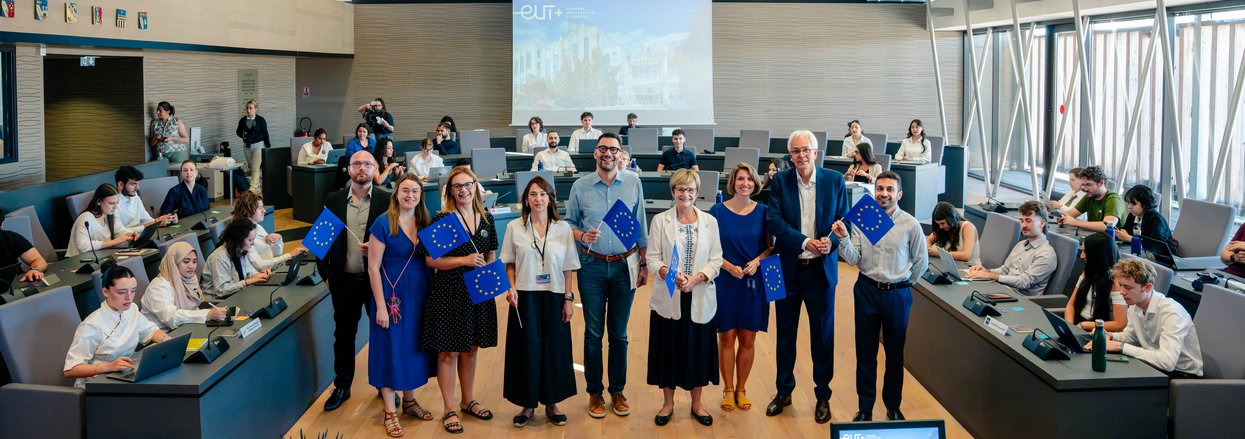
From 28 June to 3 July 2026, UTT hosted the second edition of the EUT+ Simulation Game, an intensive programme organised within the framework of the EUT+ – European University of Technology alliance. This edition was organised by Hugo Jeanningros, Nicolas Klein, Laetitia Roggero (UTT), Vicky Triga, Nikandros Ionnadis, Maria Charalambous (Cyprus University of Technology), Andreas Haidvogl and Dorina Kaiser (Hochschule Darmstadt) , For a week, 40 students representing 16 nationalities and coming from five partner universities (UTT, CUT, HDA, Università degli Studi di Cassino e del Lazio Meridionale and Universitatea Tehnică din Cluj-Napoca) slipped into the shoes of MEPs to discuss a topical issue: artificial intelligence and its regulation in Europe.
A preparation several months before the week in Troyes
The experience began in the spring with several weeks of online courses. Students discovered the functioning of the European institutions, studied the European Artificial Intelligence Act (AI Act), analysed the positions of the various political groups in the European Parliament and started working in international teams.Divided into seven political groups, they had an additional challenge: defend the positions of their political families, sometimes far removed from their personal convictions. An excellent exercise in understanding democratic mechanisms, negotiating and seeking compromise.
An immersive week to learn differently
The week organised in Troyes made it possible to transform this theoretical knowledge into concrete experience.Workshops of eloquence, negotiation, argumentation and public speaking punctuated the first days to prepare students for the parliamentary simulation.
They also met with experts to confront their reflections with the reality of European issues.
On July 1, 2026, at the Campus Cyber in La Défense, they exchanged with researchers and specialists in artificial intelligence around the challenges related to general-purpose AI models (GPAI), control mechanisms, computing power, semiconductor supply chains, the energy consumption of computing centers or the geopolitical challenges of European digital sovereignty. Discussions also focused on internship and career opportunities within this evolving ecosystem.
They then visited the Palais du Luxembourg in Paris where Senator Vanina Paoli-Gagin introduced them to the role of the Senate, its mission around the alignment of artificial intelligence with the Government and the major democratic issues related to this technological revolution.
These two visits allowed the students to enrich their knowledge before the parliamentary simulation of July 2, 2026 and to feed their future debates.
A day of debate under the conditions of the European Parliament
The highlight of the week was held in the hemicycle of the Departmental Council of Dawn.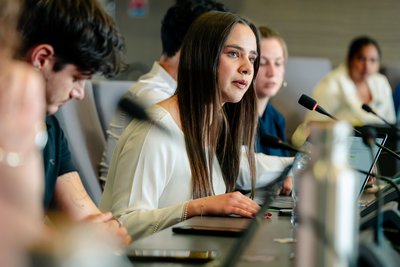 Divided into seven political groups, the students alternated speeches, debates, questions and answers, tabling resolutions, negotiations and votes in order to build compromises that would gather a majority. Klaus Pendl, a former European diplomat, took on the role of the President of the European Parliament.
To reproduce the political reality as closely as possible, two twists came to upset the debates.
In the middle of the morning, a video of activists opposed to artificial intelligence hacked into Parliament's screens, forcing political groups to react urgently. Lobbyists were also present in the room to guide the negotiations.
In the afternoon, the President of the Parliament announced the publication of a new strategic note from the European Commission, largely in favour of the development of AI and based on exchanges with researchers and innovative start-ups. The students had to adapt their positions and renegotiate their proposals.
Following the discussions, four compromise resolutions were adopted. They propose in particular to strengthen European sovereignty in the field of artificial intelligence, to develop European computing infrastructures, to support innovation by SMEs, while ensuring a framework of control, transparency and protection of citizens.
A human experience above all
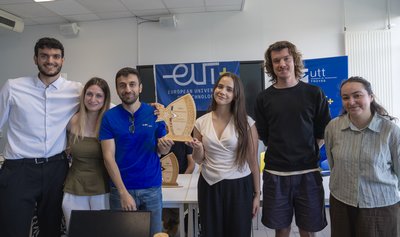 Four prizes, designed and manufactured in wood at MINDTech, the UTT fablab, collectively rewarded participants by political party:
- Coalition Builder Award: The Greens
- Diplomacy Award: Renew Europe
- Policy Innovation Award: The Left
- EUT+ Spirit Award: Patriots for Europe
As summarized by Daniela Raimondi, a student at the Università degli Studi di Cassino e del Lazio Meridionale, "Visiting an institution like the French Senate and exchanging with its representatives is an enriching experience that complements academic learning and helps to better understand the importance of dialogue, democracy and international cooperation."
This second edition fully confirms the ambition of the EUT+ alliance: train engineers, managers and scientists capable not only of mastering the technologies of tomorrow, but also of understanding their democratic, political and human implications. True to its Think Human First motto, the alliance puts people at the heart of technological innovation.

This project was financed with support from the European Commission.